Becoming MI
The person is where we begin.
Becoming MI is a place to keep developing the way we work with people. Practice a conversation, receive specific feedback, and return with something you want to do more skillfully.
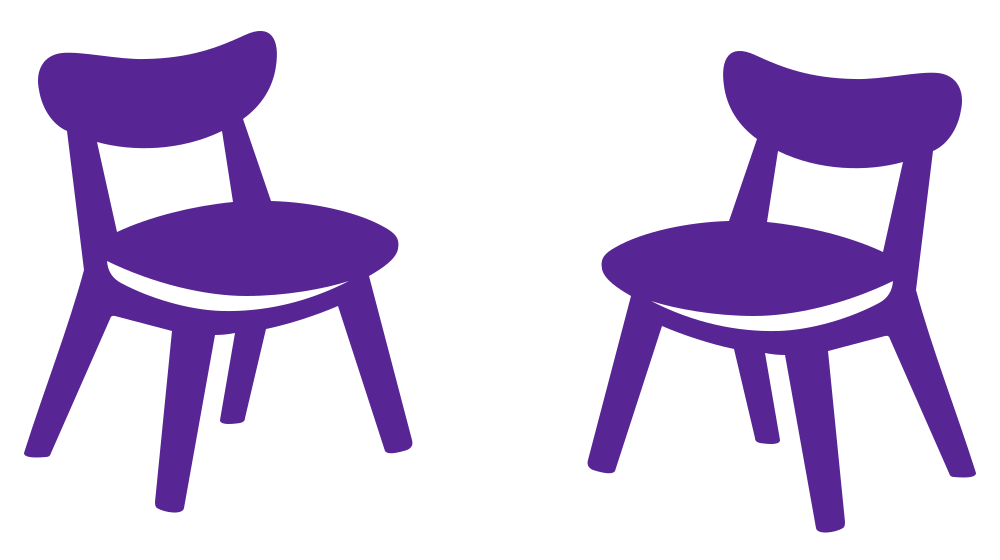
What the two chairs mean
In one chair is a person who knows their own life. They bring reasons, abilities and experience we could never supply for them. In the other is someone with a responsibility to help.
Sometimes the person says, “That isn’t what I meant.” What happens next matters. Can I set down my first explanation, hear the correction, and let it change my response?
That is what the two purple chairs stand for in Becoming MI. The practitioner has something to offer, and the person across from them has a real say in what happens next.
At the roots of the practice
Keep learning from the person.
In a joint Q&A, Stephen Rollnick writes, “In one sense, the client is our best teacher.” William Miller adds, “Clients are giving you immediate feedback about your practice.”
That directs our attention to the exchange itself. What did the person actually say? How did we respond? What did we hear next that might change our understanding?
The daily practice
An encounter to learn from.
You begin with a fictional person. The practice space gives you a situation, your role, and enough context to begin. Your task is to work with the words in front of you.
Respond in your own words. Listen to the simulated reply. After the exchange, use the review and the saved conversation to examine your choices. An optional reflection lets you record what you understood differently or what you want to work on next.
A small moment can give you a precise focus: an assumption to check, a meaning to explore, or a response to reconsider.
Your MI development
A starting point you can return to.
Your first reviewed conversation gives you a sample of how you responded. Further practice gives you more examples to compare: how you understood the person, made room for choice, held the purpose of the conversation, and adjusted when something did not fit. When change is the purpose, we also look at how you invited the person’s own motivation.
The feedback stays beside your words. Choose a focus, practice it in another situation, and look for evidence of what changed. Your dashboard brings your starting sample, recent work and chosen focus together. Completing more activities does not, by itself, establish greater skill.
Short coaching conversations help you work on a particular skill. Human review of your own recorded work can help you understand how that learning is showing up beyond the simulation.
Functional closure
The conversation is over. You’re still carrying it.
You may keep replaying what happened, feel wound up, or find it hard to settle. You might know what you intend to do and still feel unsettled. That experience deserves attention too.
Functional Closure offers a structured conversation about what happened, what remains unresolved, and what is yours to act on. It can help you work toward a clearer place to leave the experience for now, including a need for support, a next action, or something that will take time. You decide when to stop.
This belongs beside MI practice because the work affects the person doing it. The conversation uses your professional context, follows a defined process and keeps a private summary you can return to. Your optional opening and closing ratings describe how you feel, including stress and confidence; they do not establish that a problem is resolved.
Stress and anxiety can have physical effects. This chat responds to what you report. It does not measure your body, diagnose symptoms or establish physiological recovery, and physical symptoms can have other causes. Read NIMH’s explanation of stress and anxiety.
People responsible for the offering
Practice supported by AMIGA.
AMIGA’s work is led by members of the Motivational Interviewing Network of Trainers. Becoming MI connects that educational foundation with a practice structure: realistic work situations, a common set of skills, feedback linked to the exchange, and learning you can revisit.
Our quality standard calls for review of the role, situation, learning task and feedback, alongside checks that saving, navigation and account boundaries work. Automated checks support that work; they do not establish MI fidelity or learner benefit. We continue to test and refine the experience.
AI feedback can be mistaken. It is provisional learning support, not validated MITI or MICA coding, certification, or a measure of MI proficiency. Sessions run automatically and are not watched live. You can send a concern to AMIGA and choose whether to include a practice exchange for review. Functional Closure and your journal are not automatically shared through that process.
Human feedback and connection
Bring your learning into the work.
Submit a recording for human coding and written feedback, or choose the package that adds a 30-minute live consultation. The standard consultation package is $100 for one 20-minute sample; verified member pricing and availability are shown before payment. The reviewer and learner agree on MITI or MICA before review.
The practice calendar brings confirmed sessions with AMIGA into the same space. Each invitation identifies the facilitator, purpose and arrangements for joining. Dates appear when confirmed; a calendar listing is not a promise that a session is already available.
Begin with today’s practice.
Meet the person. See what you notice in the exchange.
Becoming MI is an AMIGA offering. References to Miller, Rollnick, and MINT identify its learning roots and do not imply endorsement. MINT’s guidance on learning MI →